Review Articles · Review R1
Aldicarb Poisoning: Symptoms of Poisoning Inhibitors Carbamate Acetylcholinesterase
Public First-Page Preview
Original First Page
First-page text transcription
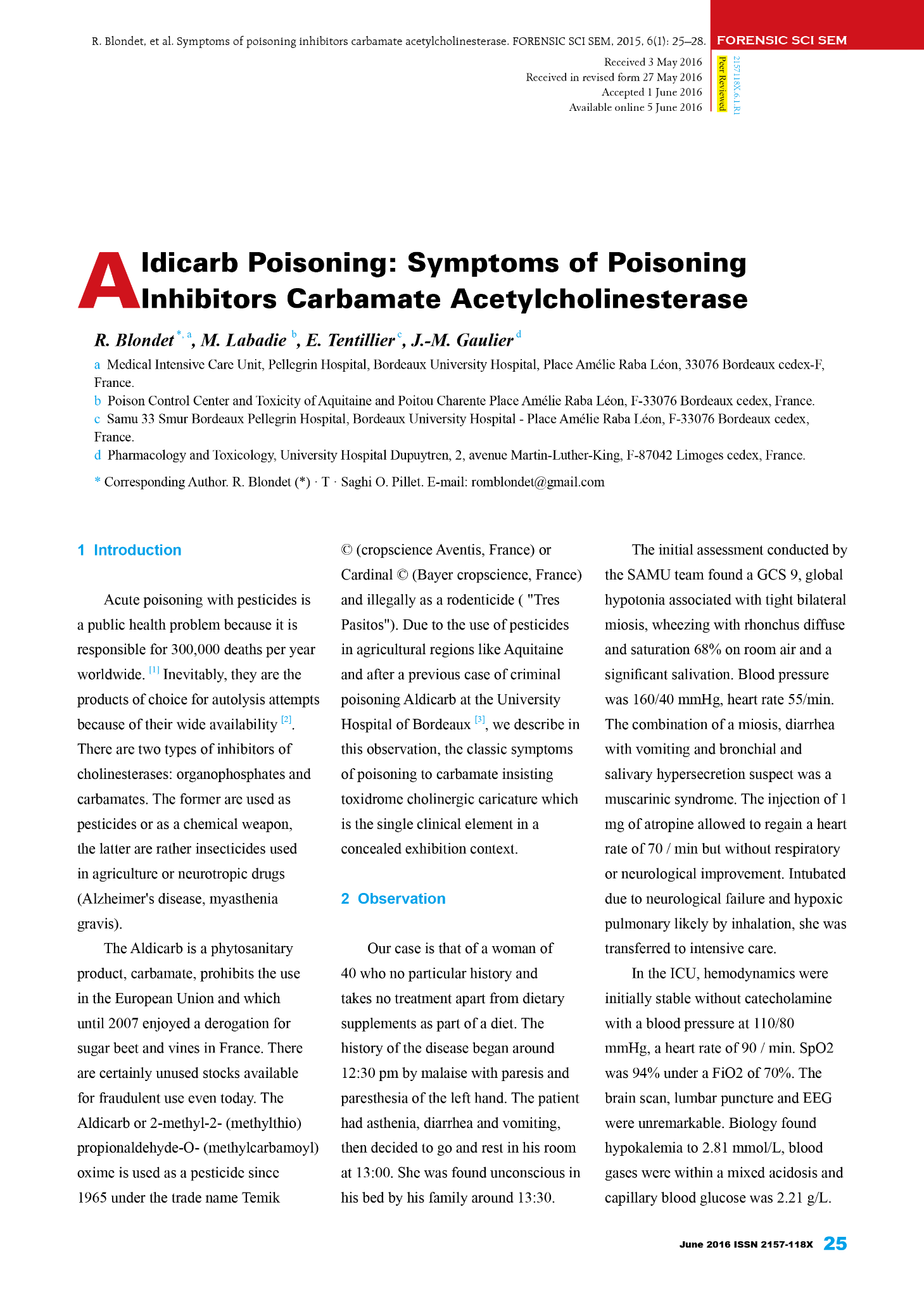
Acute poisoning with pesticides is a public health problem because it is responsible for 300,000 deaths per year worldwide. Inevitably, they are the products of choice for autolysis attempts because of their wide availability. There are two types of inhibitors of cholinesterases: organophosphates and carbamates. The former are used as pesticides or as a chemical weapon, the latter are rather insecticides used in agriculture or neurotropic drugs (Alzheimer's disease, myasthenia gravis).
The Aldicarb is a phytosanitary product, carbamate, prohibits the use in the European Union and which until 2007 enjoyed a derogation for sugar beet and vines in France. There are certainly unused stocks available for fraudulent use even today. The Aldicarb or 2-methyl-2-(methylthio) propionaldehyde-O-(methylcarbamoyl) oxime is used as a pesticide since 1965 under the trade name Temik or Cardinal and illegally as a rodenticide. Due to the use of pesticides in agricultural regions like Aquitaine and after a previous case of criminal poisoning Aldicarb at the University Hospital of Bordeaux, we describe in this observation the classic symptoms of poisoning to carbamate insisting toxidrome cholinergic caricature which is the single clinical element in a concealed exhibition context.
Our case is that of a woman of 40 who no particular history and takes no treatment apart from dietary supplements as part of a diet. The history of the disease began around 12:30 pm by malaise with paresis and paresthesia of the left hand. The patient had asthenia, diarrhea and vomiting, then decided to go and rest in his room at 13:00. She was found unconscious in his bed by his family around 13:30.
The initial assessment conducted by the SAMU team found a GCS 9, global hypotonia associated with tight bilateral miosis, wheezing with rhonchus diffuse and saturation 68% on room air and a significant salivation. Blood pressure was 160/40 mmHg, heart rate 55/min. The combination of a miosis, diarrhea with vomiting and bronchial and salivary hypersecretion suspect was a muscarinic syndrome. The injection of 1 mg of atropine allowed to regain a heart rate of 70/min but without respiratory or neurological improvement. Intubated due to neurological failure and hypoxic pulmonary likely by inhalation, she was transferred to intensive care.
In the ICU, hemodynamics were initially stable without catecholamine with a blood pressure at 110/80 mmHg, a heart rate of 90/min. SpO2 was 94% under a FiO2 of 70%. The brain scan, lumbar puncture and EEG were unremarkable. Biology found hypokalemia to 2.81 mmol/L, blood gases were within a mixed acidosis and capillary blood glucose was 2.21 g/L.
Authors & Publication
Article Details
- Medical Intensive Care Unit, Pellegrin Hospital, Bordeaux University Hospital, Place Amélie Raba Léon, 33076 Bordeaux cedex-F, France.
- Poison Control Center and Toxicity of Aquitaine and Poitou Charente, Place Amélie Raba Léon, F-33076 Bordeaux cedex, France.
- Samu 33 Smur Bordeaux Pellegrin Hospital, Bordeaux University Hospital, Place Amélie Raba Léon, F-33076 Bordeaux cedex, France.
- Pharmacology and Toxicology, University Hospital Dupuytren, 2, avenue Martin-Luther-King, F-87042 Limoges cedex, France.
Corresponding author: R. Blondet · romblondet@gmail.com
Full Text Access
Citation Information
| Document code | R1 · Review |
|---|---|
| Journal | Forensic Science Seminar |
| ISSN | 2157-118X |
| Volume / Issue | 6 / 1 |
| Pages | 25–28 |
| Publication date | 30 June 2016 |
| Article HTML | https://fss.xxyy.info/journal/2016/2157118X.6.1.R1.html |
| Full text access | Paid, password-protected PDF |
citation_pdf_url is published because the linked PDF is not freely crawlable and requires a password.
The freely accessible HTML page is the canonical scholarly landing page.